Choosing among the top Concrete Jaw Crusher manufacturers and suppliers requires more than comparing advertised power ratings. Buyers must examine feed size, crushing capacity, discharge settings, wear-part costs, energy use, and technical support. A machine may look impressive on paper, yet perform poorly with wet concrete, embedded steel, or inconsistent demolition waste.
Industry demand remains substantial. The U.S. Geological Survey reported approximately 1.5 billion metric tons of crushed stone production in the United States during 2023. Much of this material supports roads, buildings, drainage systems, and concrete production. The U.S. Environmental Protection Agency has also estimated that the United States generated about 600 million tons of construction and demolition debris in 2018. These figures highlight the practical need for reliable primary crushing equipment and efficient recycling systems.
A Concrete Jaw Crusher can provide a robust first reduction stage for large concrete pieces. Its simple compression principle suits demanding quarry and recycling applications. However, performance depends on more than the jaw chamber. Liner design, hydraulic protection, operator training, and spare-parts availability matter greatly. Site visits and verified customer references often reveal details that brochures miss.
This guide reviews leading manufacturers and suppliers through practical, evidence-based criteria. It considers product range, production consistency, after-sales service, safety features, and lifecycle value. Published market reports can offer useful direction, but their estimates are not always comparable. No ranking is perfect. Buyers should validate capacity claims using their own material, moisture levels, and operating conditions before signing a purchase agreement.
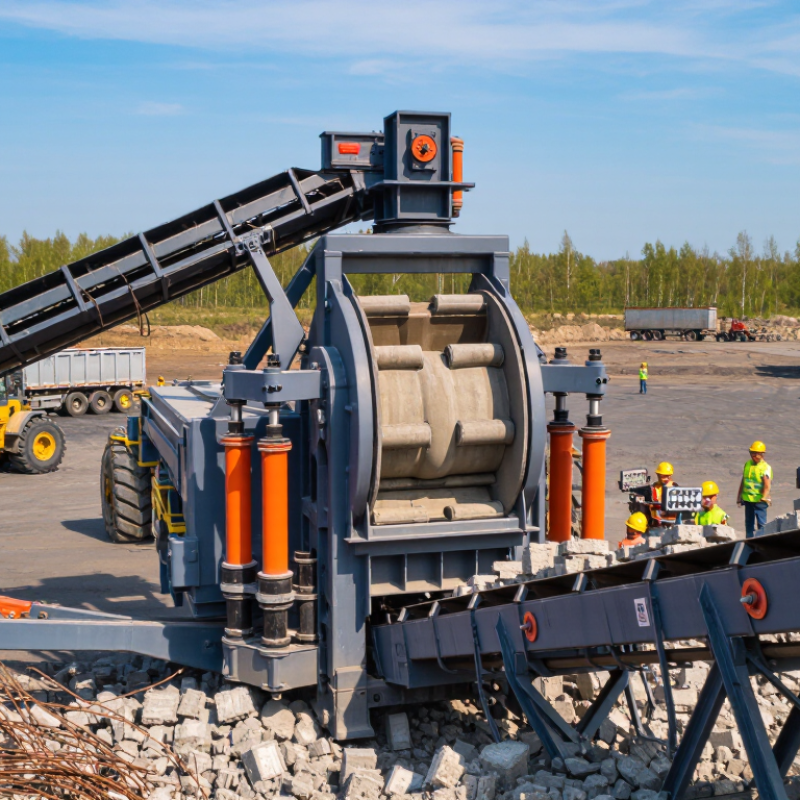
A concrete jaw crusher reduces large demolition pieces through compression between a fixed jaw and a moving jaw. Its reduction ratio compares feed size with product size. A 4:1 ratio means a 400 mm feed may produce roughly 100 mm material. A 6:1 ratio can produce a finer result, but actual performance changes with concrete strength, moisture, and reinforcement.
CSS means closed-side setting, measured at the narrowest point between the jaws. Smaller CSS usually creates smaller output, but it also increases power demand and wear. For example, a 75 mm CSS may suit secondary processing, while a 125 mm setting may protect throughput during heavy primary crushing. Operators should measure the setting regularly. Wear changes it quietly.
I have seen specifications look impressive until reinforced concrete enters the chamber. Steel bars can interrupt flow, while sticky fines may reduce capacity. This is where experienced suppliers should provide test data, capacity ranges, wear-part drawings, and clear CSS adjustment procedures. Ask how the stated 4:1–6:1 ratio was measured. Was the feed dry and uniform? Was the crusher new? Those details matter. A reliable selection also considers engine power, discharge control, maintenance access, and local service support. One useful assumption may still be wrong in practice. Test the material before committing to a machine.

Top Concrete Jaw Crusher Manufacturers and Suppliers
Leading manufacturers and suppliers now offer jaw crushers rated from 50 to 1,500 t/h. Feed openings commonly range from 200 to 1,200 mm. These figures help contractors match equipment with project scale, but they do not tell the whole story.
A 50 t/h unit may suit recycled concrete and small quarry work. Larger models can process heavy blasted rock at demanding production rates. However, actual output depends on compressive strength, moisture, feed grading, closed-side setting, and liner wear. In my experience, buyers often focus on maximum capacity and overlook the loading method. A 1,200 mm opening is useful only when the feeder and haulage system can support it. That assumption deserves checking.
Tips: Request test data using material similar to yours. Confirm the rated capacity at your planned setting, not the brochure’s highest figure. Ask about liner service life, motor power, adjustment accuracy, and spare-part availability. Review drawings before purchase. A crusher may fit the tonnage target but fail the site’s transport limits. Also, leave room for maintenance access; crowded layouts create expensive delays. Suppliers with clear test records, documented tolerances, and responsive technical support usually provide more reliable decisions. Still, every site is different. Pilot testing remains the safer choice when feed conditions are uncertain.
The chart presents the stated industry specification range for concrete jaw crushers: capacity from 50 to 1,500 t/h and feed openings from 200 to 1,200 mm. These figures describe the overall range rather than a specific company or model.
Choosing a concrete jaw crusher requires more than comparing motor power. Suppliers often list ratings from 30 to 400 kW, but power alone does not predict output. Feed hardness, moisture, chamber design, and operating speed also affect performance. A larger motor may waste energy when the feed is small or poorly graded.
Jaw profiles deserve close inspection. A deep, narrow chamber can grip bulky concrete pieces effectively, while a wider profile may handle steady recycling loads more smoothly. Corrugated plates improve bite, but they can create finer product and higher wear. In practical trials, I check the feed opening, plate condition, and actual amperage under load. The brochure rarely shows the difficult moments.
Discharge settings usually range from 20 to 300 mm. A 20 mm setting suits smaller aggregate, but it demands careful control of rebar and contamination. A 100 mm setting may improve capacity for base material. At 300 mm, the crusher handles coarser output with fewer compression cycles, though downstream screening becomes more important. Ask each supplier for measured capacity at your target size, not a maximum figure. Request power curves, liner-life estimates, noise data, and service response times. One comparison sheet is not enough. Field evidence matters more. Suppliers should also explain how CSS adjustments affect product shape, energy use, and wear. Some specifications remain vague, and that deserves scrutiny.
| Equipment Class | Typical Motor Power | Typical Feed Opening | Jaw Profile | Adjustable Discharge Size | Typical Capacity | Suitable Concrete Feed | Key Selection Considerations |
|---|---|---|---|---|---|---|---|
| Compact Laboratory / Pilot Jaw Crusher | 2.2–7.5 kW | 100 × 150 to 200 × 300 mm | Short, smooth or lightly corrugated manganese jaws | 20–50 mm | 1–10 t/h | Small concrete pieces, cured samples, and laboratory feed | Compact footprint, low throughput, and frequent CSS adjustment |
| Small Mobile or Skid-Mounted Crusher | 11–30 kW | 250 × 400 to 400 × 600 mm | Corrugated, high-grip jaw plates | 20–75 mm | 10–40 t/h | Demolition concrete and small reinforced-concrete fragments | Transportability, magnet compatibility, and rebar management |
| Medium Primary Jaw Crusher | 45–90 kW | 500 × 750 to 600 × 900 mm | Deep, corrugated profile for coarse breaking | 40–100 mm | 40–100 t/h | Quarried aggregate and heavily fragmented concrete | Required feed size, liner wear rate, and continuous-duty cooling |
| Heavy-Duty Recycling Jaw Crusher | 90–160 kW | 600 × 900 to 750 × 1,060 mm | Heavy corrugated jaws with reinforced cheek plates | 50–150 mm | 80–180 t/h | Mixed demolition waste containing concrete, brick, and limited steel | Hydraulic overload relief, tramp-metal protection, and dust control |
| Large Quarry-Scale Jaw Crusher | 160–250 kW | 800 × 1,060 to 1,000 × 1,200 mm | Deep chamber with thick, reversible corrugated plates | 75–200 mm | 150–350 t/h | Large concrete blocks and hard, abrasive aggregate feed | Foundation loads, electric supply, liner life, and primary-feed control |
| Extra-Large Primary Jaw Crusher | 250–400 kW | 1,000 × 1,200 to 1,200 × 1,500 mm | Long, deep-chamber profile for high reduction duty | 100–250 mm | 250–600 t/h | Very large reinforced-concrete sections and quarry rock | Large feed hopper, structural support, maintenance access, and energy demand |
| High-Capacity Stationary Primary Jaw Crusher | 400–630 kW | 1,200 × 1,500 to 1,500 × 2,000 mm | Extra-deep heavy-duty profile with thick replaceable liners | 150–300 mm | 500–1,000 t/h | Continuous quarry production and large-scale concrete processing | Grid capacity, plant layout, feed consistency, and automated lubrication |
| Fine-Setting Jaw Crusher Configuration | 30–110 kW | 300 × 500 to 600 × 900 mm | Close-pitch fine corrugated or smooth-faced jaws | 20–40 mm | 15–90 t/h | Pre-sized concrete for manufactured sand or secondary processing | Higher wear potential, reduced feed size, and need for downstream screening |
Note: The figures above are representative industry specification ranges for jaw-crusher configurations. Actual power, capacity, feed opening, jaw profile, and discharge setting depend on material hardness, moisture, particle shape, crusher speed, liner design, CSS, and operating conditions.
Top Concrete Jaw Crusher Manufacturers and Suppliers
In concrete recycling, a reliable jaw crusher must prove more than its rated capacity. Field testing should confirm that about 90% of the product passes the specified closed-side setting (CSS). This result depends on feed gradation, moisture, reinforcement, and operator control. CSS is not a guaranteed final particle size. That distinction matters.
Experienced suppliers provide test reports, liner specifications, and inspection records. Ask how the 90% passing rate was measured. Was the sample collected during steady production? Were steel fragments removed before screening? Small details can change the result. A practical trial using your concrete feed gives stronger evidence than a polished brochure.
Wear life commonly ranges from 1,000 to 3,000 operating hours. Abrasive aggregate, tramp metal, crushing pressure, and liner profile all affect this range. Hard, angular stone may shorten service life quickly. Softer demolition material may extend it. Not always predictable. Operators should record amperage, CSS, product size, and liner thickness each shift. These records reveal gradual performance loss before output drops sharply. One imperfect assumption can be costly: longer wear life does not always mean better crushing efficiency. A supplier with transparent limits, documented maintenance experience, and responsive technical support is usually more dependable than one offering only the highest number.
Selection should begin with compliance, not brochure capacity. A CE mark indicates conformity with applicable European safety requirements, but it does not prove crushing efficiency. Request the Declaration of Conformity, risk assessment, guarding details, and electrical documentation. Check whether the documents match the exact machine model. Small inconsistencies matter.
ISO 9001 certification is useful when its system works beyond paperwork. The ISO Survey 2022 recorded more than 1.26 million ISO 9001 certificates worldwide, showing the standard’s broad adoption. However, certification alone cannot guarantee reliable production. Ask for inspection records, nonconformity reports, calibration controls, and corrective-action examples.
A supplier should explain how jaw plates, bearings, and hydraulic components are tested before shipment. Practical evidence is stronger than polished claims.
Service capacity also deserves close attention. The USGS Mineral Commodity Summaries 2024 estimated approximately 1.5 billion metric tons of crushed stone production in the United States during 2023. That scale highlights the cost of unexpected downtime. Confirm response times, technician coverage, remote diagnostics, and commissioning support.
Spare parts should include jaw dies, cheek plates, toggle plates, belts, and bearings. Ask for stock locations and realistic delivery windows.
A low purchase price can become expensive when one unavailable bearing stops a plant. Some suppliers still provide vague service promises. Treat that as a warning, not a minor inconvenience.